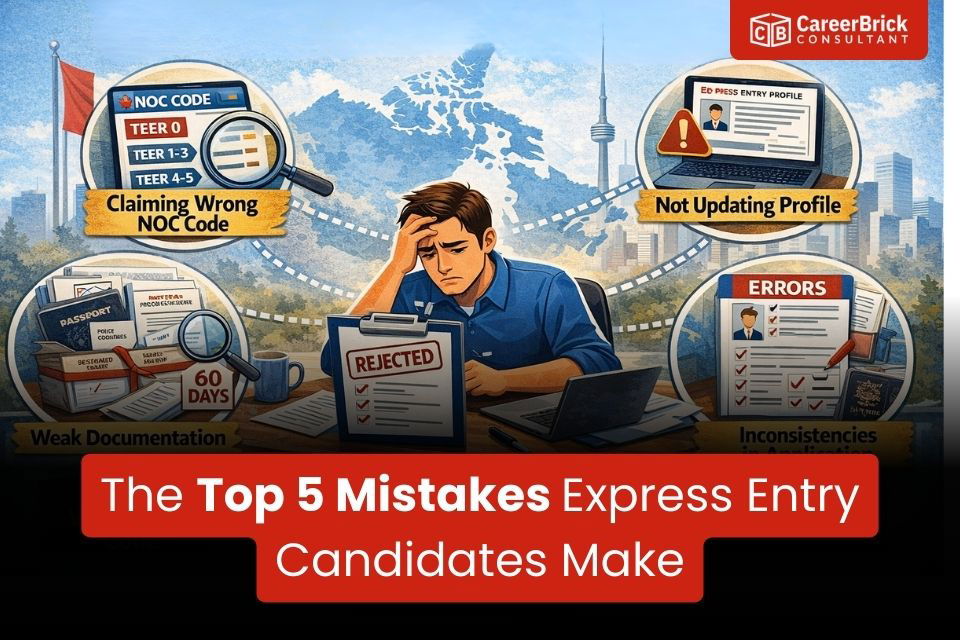
While Express Entry offers an efficient path to Canadian PR, success depends on accuracy, consistency, and thorough preparation. Many applicants unintentionally sabotage their chances through avoidable mistakes in their Express Entry profile or subsequent PR application. The five most frequent errors involve occupational classification, documentation, work experience claims, profile updates, and inconsistencies between profile and application details.
Top 5 Mistakes and How to Avoid Them
- Claiming the Wrong NOC Code Applicants frequently choose a National Occupational Classification (NOC) code based on their job title instead of the actual day-to-day duties and the official lead statement. For instance, someone titled “Maintenance and operations manager” at a restaurant might pick a facilities management NOC, but their real responsibilities could better match restaurant and food service management. Why it hurts: This can lead to the wrong TEER category (skilled TEER 0–3 vs. unskilled TEER 4–5), making you ineligible for programs like Federal Skilled Worker or Canadian Experience Class. It also risks a misrepresentation finding if duties don’t match reference letters. How to fix it: Always refer to the official Employment and Social Development Canada NOC website. Compare your routine tasks to the lead statement and main duties. Ensure employer reference letters describe your real responsibilities authentically—never copy-paste NOC descriptions.
- Submitting Weak, Incomplete, or Missing Supporting Documents You don’t upload everything when creating your profile, but after an Invitation to Apply (ITA), you have only 60 days to submit a full set (passport, language tests, ECA, reference letters, pay stubs, police certificates, medicals, photos, proof of funds, etc.). Why it hurts: Weak evidence or delays (police certificates can take months) commonly cause outright refusals. How to fix it: Gather strong, verifiable documents early while in the pool. If anything is delayed or unavailable, include a detailed Letter of Explanation (LOE) explaining your efforts and attaching any proof you have.
- Claiming Ineligible or Incorrect Work Experience Common pitfalls include counting full-time study periods, miscalculating hours (full-time = ≥30 hours/week or 1,560 hours/year; no double-counting overlaps), including expired experience (e.g., beyond the 3-year window for CEC), claiming unskilled TEER 4–5 jobs, or rounding up incomplete periods (2 years + 10 months ≠ 3 years). Why it hurts: This falsely boosts your CRS score or eligibility, leading to refusal when verified. How to fix it: Strictly follow the program-specific rules (FSWP, CEC, FSTP) for hours, recency, skill level, payment, and continuity. Be precise—never round up or assume exceptions apply.
- Failing to Update Your Express Entry Profile Changes in job, language test results, marital status, new children, or other factors must be reported promptly. Why it hurts: Outdated information can invalidate your profile, lower your CRS score unintentionally, cause mismatches with your PR application, or trigger misrepresentation concerns. How to fix it: Update your profile freely before an ITA (it won’t reset your tie-break date). Report changes immediately to stay eligible and accurate.
- Having Unexplained Inconsistencies Between Profile and PR Application Even minor differences—such as employment start/end dates (e.g., June vs. July), unexplained gaps, unreported family members, varying work hours, address history, travel records, or post-ITA job changes—can raise red flags. Why it hurts: Officers scrutinize these, leading to delays, additional requests, or rejection. How to fix it: Carefully cross-check everything for alignment. If a legitimate discrepancy exists, submit a clear Letter of Explanation (LOE) that identifies each issue, provides the reason, and points to supporting documents. Transparency improves your chances, though it doesn’t guarantee approval.
Conclusion
Avoiding these five mistakes significantly boosts your chances of receiving and successfully completing an Express Entry invitation. The key is diligence: double-check every detail, use official IRCC and NOC resources, gather documents proactively, and explain any issues transparently with LOEs. While the system rewards accuracy, even honest errors can be costly—so consider consulting a licensed immigration professional or Regulated Canadian Immigration Consultant (RCIC) for complex cases. Stay updated via official IRCC channels, as rules and draws evolve. With careful preparation, Express Entry remains one of the most reliable paths to Canadian permanent residence. Good luck!