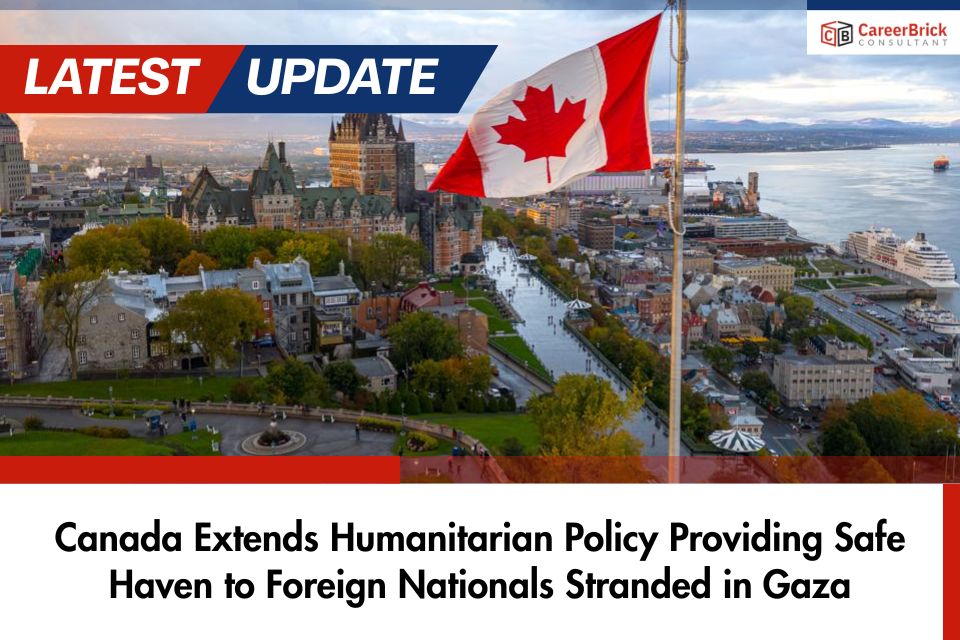
In a significant development for individuals affected by the ongoing conflict in Gaza, Immigration, Refugees and Citizenship Canada (IRCC) has announced an extension of its temporary public policy designed to offer safe haven to foreign nationals stranded in the region. This policy specifically targets those who already hold an approved Canadian temporary resident visa (TRV) issued under previous iterations of the special measures. The extension grants these individuals nearly two additional years to travel to Canada as visitors, providing critical relief amid challenging circumstances.
The updated policy officially takes effect on April 24, 2026, and is set to remain in place until March 31, 2028. However, it is important to note that, like many temporary public policies, it remains subject to revocation by the Canadian government at any point during this timeframe if circumstances change. This extension builds directly on earlier versions of the initiative, underscoring Canada’s continued commitment to supporting those impacted by the humanitarian situation in Gaza through targeted immigration flexibilities.
Who Qualifies for the Extended Policy?
Eligibility under this extended measure is straightforward but precise. The policy applies exclusively to foreign nationals who:
- Currently hold a valid temporary resident visa (TRV) that was originally issued under the facilitation measures of the previous temporary public policy for individuals in Gaza; and
- Intend to enter Canada specifically as a visitor (not for work, study, or other purposes).
This targeted approach ensures that the benefits are directed toward those who have already navigated the earlier application process and received approval, allowing them to focus on the logistics of travel rather than reapplying from scratch. It does not open the door for new TRV applications, as the application facilitation components of the original policy have already expired.
What Exactly Does the Extended Policy Provide?
At its core, the policy offers meaningful exemptions from standard entry requirements that would otherwise apply to visitors seeking admission to Canada. Under normal circumstances, a foreign national arriving at a Canadian port of entry as a visitor must demonstrate two key things to the examining officer:
- That they will leave Canada at the end of their authorized period of stay; and
- That they are not inadmissible on financial grounds (meaning they have sufficient funds to support themselves and will not become a burden on Canadian society).
These requirements can be particularly difficult to meet for individuals coming from conflict zones like Gaza, where documentation, financial stability, and future plans may be severely disrupted. The temporary public policy removes these specific barriers for eligible holders of the Gaza-related TRVs. As a result, qualifying individuals can enter Canada without being refused on these grounds alone.
It is crucial to emphasize that the exemptions are limited. All other standard eligibility criteria for visitors—such as health, security, and criminal admissibility checks—continue to apply in full. Travelers must still meet general visitor visa requirements, including any biometrics, medical exams, or other procedural steps that may have been part of their original TRV approval. The policy does not grant permanent residency or any long-term status; it simply facilitates temporary entry as a visitor for those already approved under the special measures.
Background and Evolution of the Gaza Special Measures
To fully understand the significance of this latest extension, it is helpful to review the history of Canada’s Gaza-specific immigration measures. The program was first introduced by IRCC in December 2023 as an emergency response to the escalating Israel-Hamas conflict. It was later refined and replaced with an updated version in April 2024, which introduced a more structured three-part framework aimed at providing both application support and entry flexibility for Palestinian nationals from Gaza with close family ties in Canada.
The original and updated policies were designed to create a temporary pathway to safety for those with Canadian citizen or permanent resident family members (referred to as “anchors”) who could commit to providing one year of settlement support. This support included assistance with housing, food, orientation to Canadian life, and enrollment in essential services such as health insurance.
The three parts of the April 2024 policy were as follows:
- Part 1: Established a facilitated temporary resident visa (TRV) application pathway specifically for Palestinian passport holders physically located in Gaza at the time of application. Applicants were required to have a willing Canadian “anchor” family member prepared to offer the aforementioned settlement support.
- Part 2: Extended the same facilitated application process to immediate family members (such as spouses and dependent children) traveling alongside the primary Part 1 applicant.
- Part 3: Focused on the entry component. This part allowed approved applicants from Parts 1 and 2 to actually enter Canada as visitors, even if they could not fully satisfy the standard proof-of-departure or financial requirements described earlier.
Parts 1 and 2—the application facilitation stages—have since expired. A cap of 5,000 applications was placed on processing under the updated policy, and no new applications are being accepted through this route. However, Part 3 (the entry exemptions) has proven particularly valuable and has now been extended multiple times. The first extension, signed in March 2025, carried the entry provisions forward until April 23, 2026. The current extension—signed on April 20, 2026—provides a much longer window, running through March 31, 2028. This extended timeline gives approved individuals far greater flexibility to arrange travel when conditions on the ground allow safe departure from Gaza.
The complete official text of the extended temporary public policy is publicly available on the Government of Canada’s website for those seeking the most authoritative source.
Why This Extension Matters
For many foreign nationals still stranded in Gaza despite holding approved Canadian TRVs, this announcement brings renewed hope and practical relief. The ongoing conflict has made international travel extremely difficult, with limited commercial options, border restrictions, and safety concerns delaying departures for months or even years. By removing key entry barriers and providing nearly two more years of validity, Canada is effectively keeping the door open for these individuals and their families to reach safety and begin rebuilding their lives, even temporarily.
This policy reflects a broader Canadian approach to humanitarian immigration measures during global crises, balancing compassion with controlled, targeted support for those with established family connections in Canada. It also serves as a reminder that while application pathways may close, entry provisions for already-approved cases can be extended to adapt to evolving situations.
Individuals who believe they may qualify are encouraged to review the official policy details carefully and consult with a regulated immigration professional if they have questions about their specific circumstances or next steps. As always, conditions can change, so staying informed through official IRCC channels is essential.
This extension underscores Canada’s ongoing role in providing temporary safe haven amid international humanitarian challenges, offering a lifeline to those who have already taken the important first step of securing approval under the earlier Gaza measures. For affected families, it represents not just policy language, but a meaningful extension of time to reach safety and stability in Canada.