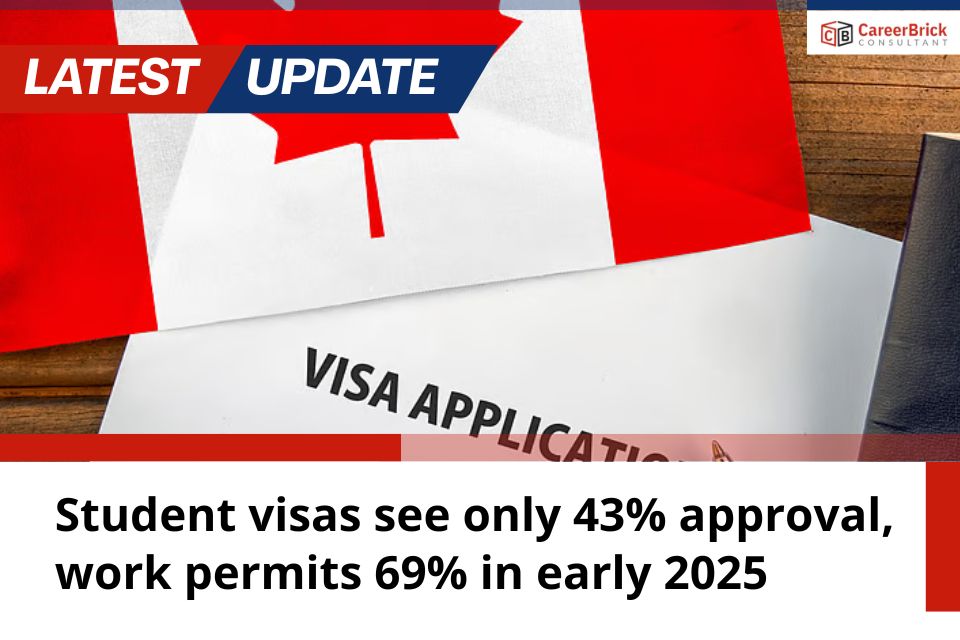
Immigration, Refugees and Citizenship Canada (IRCC) has released new figures for the first four months of 2025, revealing notable differences in approval rates across temporary and permanent resident categories. The data highlights strong results for family sponsorship and certain economic programs, but also shows that student visa applicants and some skilled worker streams continue to face tighter scrutiny.
Between January and April 2025, work permits accounted for a large share of temporary resident admissions. The overall approval rate for work permits stood at 69%, representing 125,305 admissions. Within this category, some programs performed much better than others. For instance, the Agriculture NOC stream and the Temporary Foreign Worker Program both reported approval rates of 92%, while the International Experience Canada (IEC) program lagged behind at just 49%. Extensions under international mobility streams were also relatively successful, with an 89% approval rate.
Study permits, however, presented a different picture. Applications in this category were met with far stricter evaluation. Out of 182,404 applications, only 43% were approved, leading to 78,620 admissions. The Student Direct Stream (SDS) reflected the same 43% approval rate, while study permit extensions fared somewhat better at 52%. In comparison, visitor programs performed strongly, with Visitor Record Extensions seeing approvals at 91% and Super Visas at 77%.
Permanent residency pathways displayed greater variation. Among Express Entry programs, the Canadian Experience Class (CEC) stood out with a 94% approval rate, leading to 21,820 admissions. The Federal Skilled Worker Program was considerably lower at 52%, while the Skilled Trades Program recorded a 63% approval rate. The Agri-Food Pilot also showed resilience, with 72% of applications approved.
Family reunification streams maintained consistently high outcomes. Spousal and dependent applications generally performed well, with approval rates ranging from 81% to 92%. The RoC Spouses, Partners, and Children (Domestic) program topped this category with a 92% success rate.
Humanitarian and refugee programs reflected mixed outcomes. Government-assisted Refugees achieved an 82% approval rate, while Privately Sponsored Refugees stood at 69%. By contrast, Protected Persons in Canada experienced one of the lowest results, with only 45% of applications approved.
Overall, the figures underline the uneven nature of Canada’s immigration landscape in early 2025. Programs linked to family reunification and Canadian work experience continue to deliver strong outcomes, while international students and certain skilled worker categories are experiencing tougher scrutiny and lower acceptance rates.