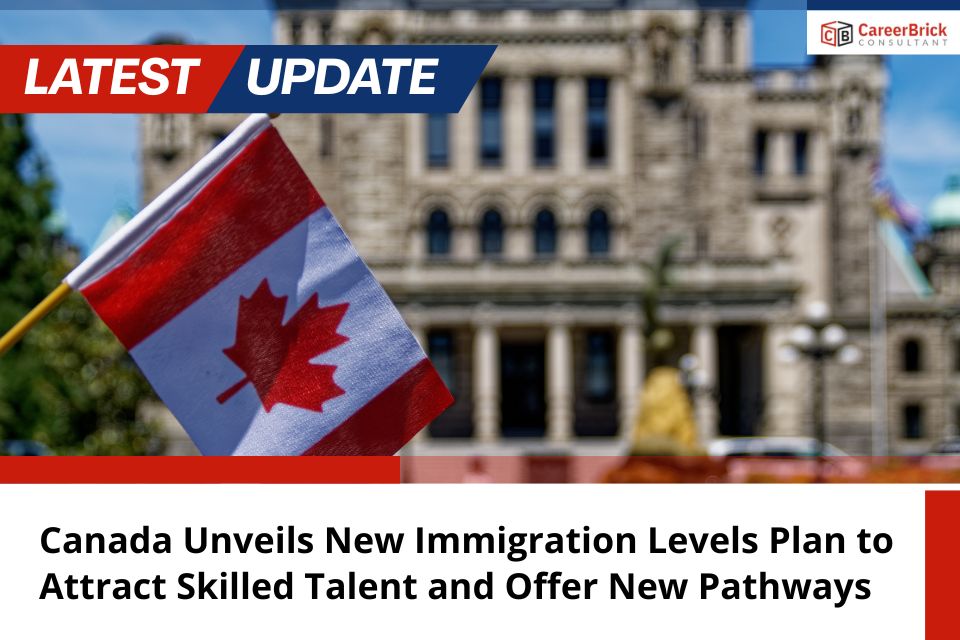
The Canadian government has announced a major update to its immigration strategy as part of its federal budget and long-term workforce planning. Under Prime Minister Mark Carney, Canada has set new targets and policies aimed at shaping its immigration system from 2026 through 2028, with a strong emphasis on attracting highly skilled talent and creating clearer paths to permanent residency.
Stable Permanent Residency Targets Set for 2026–2028
Canada’s updated plan sets a goal to welcome around 380,000 new permanent residents each year from 2026 through 2028. These figures reflect a more consistent and predictable approach to immigration than in previous years. By establishing steady targets, the government hopes to support economic growth, address key labour shortages, and ensure that its labour market remains competitive internationally.
A significant portion of these planned admissions is expected to focus on economic immigration streams — including skilled workers, international graduates, and other pathways that help fill workforce gaps in sectors such as technology, healthcare, and research.
Special Focus on Skilled Professionals and Researchers
One of the main highlights of the announcement is a new emphasis on attracting top global talent, especially skilled professionals and researchers. The federal budget includes substantial investment plans to recruit more than 1,000 international researchers, underlining Canada’s intent to boost innovation and strengthen its research ecosystem. The government believes that these individuals will play a key role in advancing Canada’s competitiveness on the global stage.
To support this goal, Ottawa is planning an “accelerated pathway” for holders of H‑1B visas — a type of work visa common in the United States for highly skilled tech and specialist employees. This new pathway is designed to make it easier for these professionals — who may face high costs and barriers under recent U.S. visa policy changes — to relocate and settle in Canada on a faster track.
Policy Shift: Fewer Temporary Residents, More Long-Term Stability
Alongside its expanded focus on attracting permanent residents, Canada is also planning to scale down the number of temporary residents entering the country. Under the new strategy, the number of temporary residents — including temporary foreign workers and international students — is expected to drop by about 40% compared with current levels. Government projections suggest that the total temporary resident population could fall to approximately 385,000 in 2026, with similar figures planned for 2027 and 2028.
This reduction reflects a broader goal of fostering long-term settlement rather than relying heavily on temporary stays. By lowering the proportion of non-permanent residents to under 5% of the total population, policymakers hope to ease pressures on public services, housing, and infrastructure — while still supporting economic productivity through strategic admissions.
More Permanent Paths for Work Permit Holders
Another key component of the updated levels plan is the intention to help existing work permit holders transition to permanent residency. Under new measures, tens of thousands of temporary workers in Canada — including individuals already contributing to the labour market — are expected to be supported in moving toward permanent status over the next few years. This reflects a growing recognition that many temporary residents possess skills that are valuable to Canada’s economy.
What This Means for Immigration Candidates
For international applicants and skilled workers considering Canada as a destination, the updated plan offers several important takeaways:
-
Permanent residency opportunities remain strong with consistent annual targets.
-
Skilled professionals and researchers have new incentive structures and programs designed to draw global talent.
-
H‑1B visa holders in particular could benefit from streamlined pathways due to shifting policies in North America.
-
Temporary stay routes such as study and work permits will be more limited, emphasizing the value of transitioning to permanent status.
Overall, Canada’s new immigration strategy marks a significant policy evolution — balancing economic growth with sustainable population planning and long-term integration of newcomers. These changes aim to make Canada an even more attractive destination for skilled migrants while ensuring that immigration levels align with public services and community capacity.